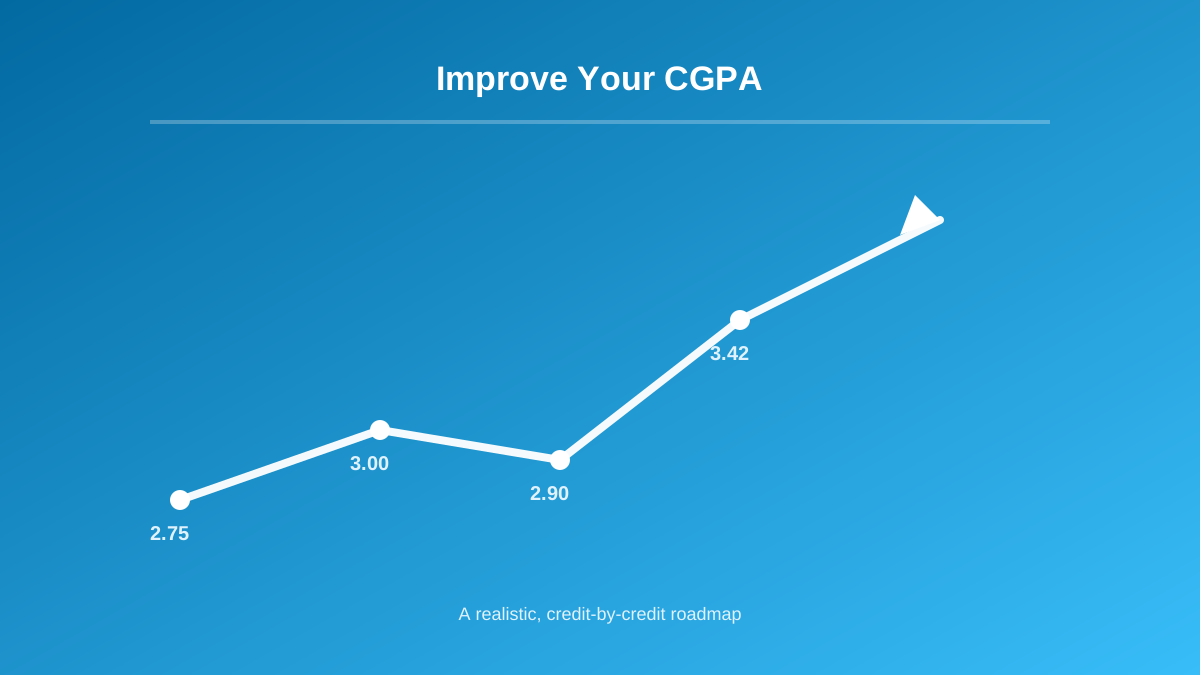
"If I retake this one course, how much will my CGPA actually go up?" is probably the most common question NU students type into a search bar right before an improvement exam deadline — and it's a genuinely hard number to guess without doing the math, because the honest answer is: it depends on how many total credit hours you've already piled up.
This guide breaks down the actual arithmetic behind CGPA movement, what the improvement exam system does and doesn't let you do, and a study approach that prioritises the retakes that are actually worth your limited time.
Why the Same Retake Moves a 1st-Year CGPA More Than a Final-Year One
Your CGPA is a credit-weighted average across every course you've ever taken. That means every additional credit hour you accumulate "dilutes" the impact any single course can have on the overall number. Retaking a 4-credit course in first year — when your total credit load might only be 24 — moves the needle far more than retaking that same course after you've already completed 90+ credits toward your degree.
This isn't a reason to give up on later-year improvements. It's a reason to be deliberate about which ones you choose.
The Formula: How Much a Retake Actually Changes Your CGPA
The approximate shift in your overall CGPA from a single course retake is:
ΔCGPA ≈ (New Grade Point − Old Grade Point) × Course Credit ÷ Total Credit Hours (all years)
Here's what that looks like in practice. Say a student has completed 90 total credit hours, sitting at a 3.10 CGPA, and retakes a 4-credit course, moving it from a C (2.25) to an A- (3.50):
(3.50 − 2.25) × 4 ÷ 90 = 1.25 × 4 ÷ 90 = 5.0 ÷ 90 ≈ 0.056
That single retake lifts the CGPA from roughly 3.10 to about 3.156 — real progress, but not the dramatic jump many students expect from "fixing" one bad grade. Compare that to the same retake done at 24 total credits instead of 90:
(3.50 − 2.25) × 4 ÷ 24 = 5.0 ÷ 24 ≈ 0.208
Nearly four times the effect, for the exact same grade improvement — purely because of when it happens. You can plug your own numbers into the CGPA calculator to see this play out with your actual courses and credits rather than estimating it.
What the Improvement Exam System Actually Allows
A few rules apply broadly across NU's improvement system, though exact eligibility windows and grade thresholds are set year to year by official notice, so always confirm the current version before planning around it:
- Replacement, not averaging. The improvement grade replaces the original in your CGPA — it doesn't blend the two attempts together.
- Eligibility is grade-dependent. Whether you can sit an improvement exam for a given course usually depends on the grade you already have, with different rules for a pass-but-weak grade versus a referred/failed course.
- There's a time window. Improvement exams are offered within specific exam cycles, not on demand, so missing a cycle can mean waiting for the next one.
Because these specifics change, treat this section as the general shape of the system and verify current eligibility with your college's exam section before committing study time to a particular course.
A Realistic Year-by-Year Improvement Roadmap
Step 1 — List every course credit and grade you have so far
Before deciding what to retake, get the full picture. Enter your existing results into the calculator for your department and syllabus, and note the credit hour next to each grade — this is the raw data every decision below depends on.
Step 2 — Rank courses by credit hours, not by how bad the grade feels
A C+ in a 4-credit core course is usually worth more attention than a C in a 2-credit elective, even if the elective grade "feels" worse. Use the ΔCGPA formula above to compare actual impact rather than gut feeling.
Step 3 — Be honest about how many grade points you can realistically gain
Jumping from an F to an A+ sounds great on paper but rarely reflects how much you can prepare in one exam cycle alongside your regular coursework. A believable jump — say, C to B+ — used in the real formula usually beats an optimistic guess that doesn't hold up.
Step 4 — Study from the actual exam pattern, not just the textbook
NU written exams follow fairly consistent question patterns year to year within a course. Past question papers from your own department — available through seniors, college libraries, or department Facebook groups — usually tell you more about what to prioritise than re-reading an entire textbook cover to cover.
Step 5 — Re-run the calculator after each result
Every time a new result comes in, update it in the calculator and see your running CGPA change. Watching the real number move, instead of estimating it, keeps your remaining improvement choices grounded in actual numbers rather than assumptions.
Whichever department you're in — Statistics, Arabic, or Anthropology — the same credit-weighted calculator handles the ΔCGPA math for you automatically once you enter a retake's new grade.
Frequently Asked Questions
Can I improve my CGPA after finishing all four years?
Improvement eligibility depends on current official rules for your grade and year, so this should be confirmed with your college rather than assumed — but generally, earlier retakes give you more scheduling flexibility.
Does retaking a course average the old and new grade?
No — the new grade point replaces the old one in your CGPA calculation.
If I can only retake one course, which should it be?
The one with the highest credit hours and the largest realistic grade-point jump, since CGPA movement scales with both factors together, not either one alone.