Somebody asks "what's your GPA?" and somebody else answers with what's actually their CGPA, and nobody in the conversation notices the mismatch — because most people use the two terms interchangeably, including plenty of professors. They're not the same number, though, and mixing them up is an easy way to misjudge your own academic standing, especially right before you apply somewhere that asks for one specifically.
The Short Answer
GPA (Grade Point Average) measures a single, defined stretch of study — usually one semester or one academic year. CGPA (Cumulative Grade Point Average) measures everything you've completed so far, added together. Your GPA resets its scope every term. Your CGPA never resets — it just keeps absorbing more data as you go.
Put another way: GPA answers "how did I do in this specific period?" CGPA answers "how have I done overall, up to this point?" Both use the same underlying grade-point scale and the same credit-weighting math — the only real difference is how much of your academic history each one is looking at.
GPA vs CGPA, Side by Side
| Question | GPA | CGPA |
|---|---|---|
| What period does it cover? | One term, semester, or year | Every term completed so far |
| Does it reset? | Yes, a new one each term | No, it's cumulative |
| Formula | Σ(grade point × credit) ÷ credit, for that term | Σ(grade point × credit) ÷ credit, across all terms |
| How much does one bad course move it? | A lot — small total credit base | Less — diluted by every prior term's credits |
| Where does it appear? | Each term's individual result sheet | Final certificate and transcript summary |
| What do employers/admissions usually ask for? | Rarely asked for alone | Almost always this one |
The table above is really the whole concept in six rows — everything else in this post is just examples showing why that "dilution" row matters more than it looks.
Why the Confusion Happens
Part of it is genuinely regional. In systems like NU's, "GPA" and "CGPA" are deliberately two separate, named figures on your result sheet. In a lot of other university systems — especially in North America — there's often just one running number people casually call a "GPA," even though it's functionally doing the same job a CGPA does here. So if you've seen both usages online, you've technically seen two different conventions, not a contradiction.
The other part is just habit: once you're used to hearing "GPA" as a catch-all word for "my grades," it's easy to keep using it even after you've moved from talking about one term to talking about your whole degree.
None of this works without understanding how a single grade point gets calculated in the first place — if that part is still fuzzy, our grading system breakdown covers the marks-to-letter-grade conversion this whole formula depends on.
A Worked Example
Say a student has finished three years, with these yearly GPAs and credit loads:
| Year | Credit Hours | Yearly GPA |
|---|---|---|
| 1st Year | 24 | 2.95 |
| 2nd Year | 24 | 3.20 |
| 3rd Year | 26 | 3.55 |
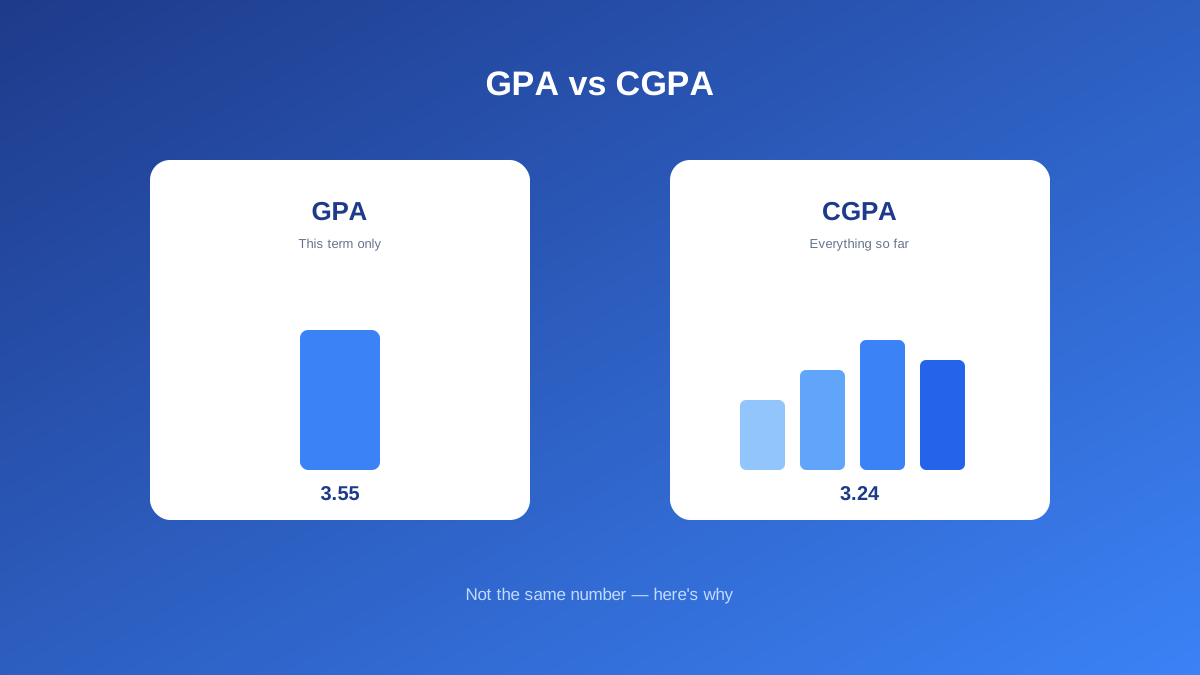
Their 3rd-year GPA is simply 3.55 — that year, on its own, nothing else factored in. Their CGPA, though, blends all three years together using each year's credit hours as weight:
CGPA = (2.95×24 + 3.20×24 + 3.55×26) ÷ (24+24+26) ≈ 3.24
Notice the gap: a 3.55 GPA this year, but only a 3.24 CGPA overall. Neither number is "wrong" — they're just answering different questions. A student quoting their 3.55 without clarifying it's this year's figure, not their cumulative one, is giving a technically true but potentially misleading answer.
A Second Example: Why a Big Improvement Barely Moves CGPA Later On
The first example showed the gap when someone is only three years in. Here's what happens to that same kind of jump once a student has built up much more credit history — say, they're finishing a 4th year with 92 total credit hours already completed, sitting at a 3.10 CGPA, and their final year comes in strong at 3.70 GPA on 26 credit hours:
New CGPA = (3.10 × 92 + 3.70 × 26) ÷ (92 + 26) = (285.20 + 96.20) ÷ 118 ≈ 3.23
A genuinely strong final year — 0.60 higher than their running average — only moved the overall CGPA from 3.10 to about 3.23. Compare that to how much a similarly-sized jump moved the 3-year student's number above. This is the same "dilution" effect from the comparison table: the more total credit hours already banked, the smaller a percentage swing any single term can create, no matter how good that term was.
Which One Actually Matters
For most practical purposes — job applications, higher study admissions, scholarship eligibility — it's the final CGPA that gets asked for and printed on your certificate. Your individual yearly GPAs matter mostly as a way to track your own trend and to figure out which specific year (and which specific courses within it) are worth an improvement attempt, which we cover in more depth in our CGPA improvement guide.
This applies the same way regardless of department — whether you're tracking a Mathematics CGPA, a Bangla CGPA, or a Sociology CGPA, the underlying credit-weighted formula is identical — only the course list and credit hours change from one department to the next.
Calculate Both, Instantly
If you want to see your own GPA-per-term and running CGPA side by side without doing the credit-weighted math by hand, our free GPA & CGPA calculator handles both at once — add each semester or year as a group, enter your subjects and credit hours, and it shows you each term's GPA plus your overall CGPA as you go. If you're specifically a National University student, the department-specific calculator on our homepage is even faster since your exact courses are already loaded.
Frequently Asked Questions
Is a higher GPA always better than a lower CGPA?
They're not directly comparable — one covers a single term, the other covers your whole academic history. A great single term doesn't erase a weaker overall CGPA.
Which number goes on my final certificate?
Your cumulative CGPA — not any individual term or year's GPA.
Can my CGPA barely move even if my latest GPA improved a lot?
Yes, and that's expected. The more total credit hours you've already built up, the smaller a single strong term's effect on your overall average.
Does this GPA-vs-CGPA relationship apply the same way in every department?
Yes — the credit-weighted formula is identical everywhere. Only the specific courses and credit hours differ from one department to another.