When I sat in Mathematics classes at Government Azizul Haque College, Bogura, first year felt brutally heavy — week after week of new papers piling on. I assumed every department felt the same. Years later, after transcribing the entire National University syllabus into this site's database — 3,081 course entries, one at a time — I finally had a way to check: was my first year actually heavier than everyone else's?
This post is the answer. I counted every first-year course and credit in the 2024–2025 Honours transcription: 36 departments, 383 courses, 1,322 credits — and ranked them all. (And yes: Mathematics sits at #2. My first year really was that heavy.)
The ranking: all 36 first years, heaviest first
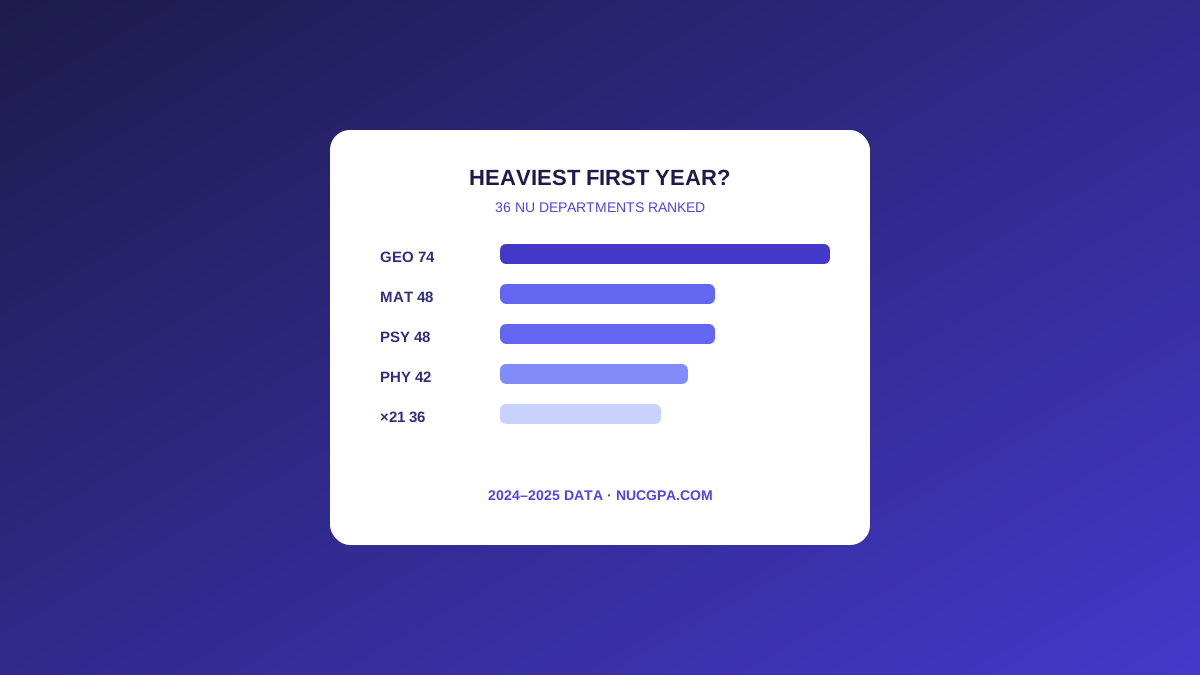
Here are the five departments that stand above the pack. The full 36-department table is downloadable as a CSV at the bottom of this post.
| Rank | Department | Courses | Credits | Share of degree |
|---|---|---|---|---|
| #1 | Geography and Environment (BSc) | 22 | 74 | 35.6% |
| #2 | Mathematics (BSc) | 15 | 48 | 30.4% |
| #2 | Psychology (BSc) | 13 | 48 | 27.3% |
| #4 | Physics (BSc) | 13 | 42 | 28.4% |
| #4 | Environment Science (BSc) | 13 | 42 | 29.6% |
Below them, 21 departments tie at exactly 36 credits — including Zoology, Botany, Chemistry, Political Science, Bangla, English and History — then 8 departments at 32 (all four BBA subjects plus Economics, Sociology, Social Work and Library and Information Science), and finally the two lightest first years in the data: Anthropology and Arabic at 28 credits each (8 courses).
The shape of the data: one giant, one standard, one floor
Plotted as a distribution, NU first years fall into an unusually clean pattern — a lone outlier, a dominant standard, and a small floor:
The median first year is exactly 36 credits and the mean is 36.7 — the mean sits barely above the median because a single department, Geography, drags it up all by itself. If you are a first-year student carrying 36 credits across 10 or 11 courses, congratulations: you are the single most typical NU student in existence.
Why Geography and Environment explodes off the chart
74 credits is not a typo, and it is not a data error — I checked both. The first-year list contains 22 distinct course codes with zero duplicates, and the older 2013–2014 syllabus tells the same story (20 courses, 66 credits). What is happening is structural: only 4 of those 22 papers are core Geography. The other 18 are allied papers drawn from a dozen different disciplines — Chemistry, Botany, Zoology, Statistics, Mathematics, Economics, Sociology, Social Work, Political Science and Psychology.
Geography is genuinely the most interdisciplinary first year NU offers, and its students pay for that breadth in workload: more than a third of the entire degree (35.6% of 208 credits) lands in year one. One honest caveat — how allied papers are administered can vary by college, so an individual student's personal load may be lighter than the syllabus lists. The ranking reflects the syllabus as published, which is also exactly what our Geography and Environment calculator loads for you.
Is first year your heaviest year? Probably not
Here is the finding that surprised me most. Among the 30 departments with complete four-year data, only four peak in first year: Geography, Mathematics, Physics and Environment Science. Everybody else peaks later — usually in fourth year. Economics climbs to 48 credits in fourth year, Statistics to 46, English to 44. And the single heaviest non-Geography year anywhere in the data belongs to Psychology's second year: 56 credits of syllabus papers.
The practical lesson: if your first year felt manageable, do not assume the degree stays that way — for most departments the load curve slopes upward. And if your first year felt crushing (Mathematics students, I see you), take some comfort: for you, the worst is genuinely front-loaded.
What this means for your CGPA strategy
Credit load is not difficulty — a 4-credit theory paper and a 4-credit practical demand very different things. But load does set the stakes of each year, because every credit carries equal weight in the CGPA formula. A first year worth 30% of your degree (Mathematics) punishes early stumbles far more than one worth 22% (Anthropology, Arabic).
Two rules follow. First, front-load your effort, not just your timetable: early credits anchor your CGPA for the rest of the degree, and no late surge fully erases a weak start — the math is laid out in our CGPA improvement guide. Second, weight your revision by credits, not by fear: an extra grade-step in a 4-credit paper moves your GPA twice as far as the same step in a 2-credit paper. Our department calculators show every credit pre-loaded, so you can see exactly where each point comes from.
Methodology and limitations
Source: this site's course database, transcribed entry-by-entry from the official NU syllabus portal (see our Sources & Methodology page). Scope: Honours programmes, 2024–2025 syllabus, 36 departments. Counts reflect required courses as listed; first-year rows in this syllabus contain no synthetic entries, so the ranking is unadjusted. For cross-year comparisons, second-year totals were reduced by the 8 common credits (Applied ICT + Functional English) our calculator adds to every second year, so all years are compared on syllabus papers alone.
Limitations, stated plainly: six departments (the five Music streams and Pali) currently have first-year data only in our transcription, so they appear in the first-year ranking but are excluded from every degree-share claim. Allied-paper administration can vary by college (see the Geography caveat above). And credit load measures volume, not difficulty — treat this as a map of how much, not how hard.
Download the full data
NU Honours first-year load, 2024–2025 (CSV)
All 36 departments: first-year credits and course counts, programme totals, first-year share, and each degree's heaviest year. Free to reuse with credit.
Download the CSV (36 rows)Found a course that changed in a revised syllabus? Tell us through the contact page — confirmed corrections ship in the shared data file, and this ranking gets recomputed with them.
Frequently asked questions
Which NU department has the heaviest first year?
Geography and Environment (22 courses, 74 credits), followed by Mathematics and Psychology (48 each).
How many credits is a typical NU first year?
Median exactly 36 credits — 21 of 36 departments sit there. Mean 36.7.
Is first year the heaviest year of an NU degree?
Usually not — only 4 of 30 complete departments peak in first year. Most peak in fourth year.
Where can I download the full ranking data?
As a free CSV on this page — 36 rows with credits, course counts, totals and heaviest years.